What are the flat, elongated brown beetles in the grain?
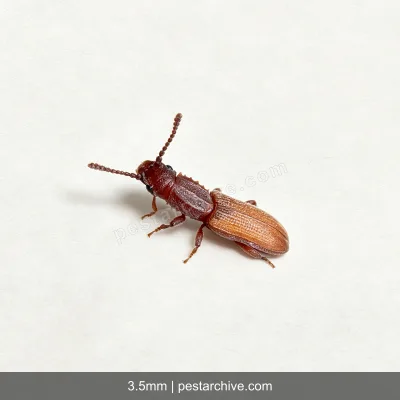
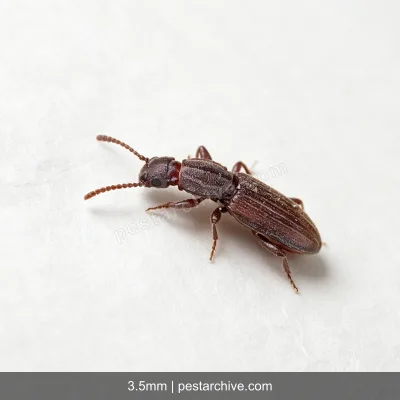
What are the flat, elongated brown beetles in the grain?
Flat, elongated brown beetles found in grain are likely grain borers (flat grain beetles). There are two main types: the larger grain borer (or saw-toothed grain beetle) and the saw-toothed grain beetle. Their flat bodies allow them to crawl into very narrow crevices, making them prone to spreading through cabinets.
What does the larger grain borer look like?
- Larger grain borer: Body length up to nearly 1 cm (8-11 mm).
- Body flattened, dark brown, shiny.
- Head triangular with strong, well-developed mandibles.
- Larvae are also flat, greyish-white, pointed at both ends.
What does the saw-toothed grain beetle look like?
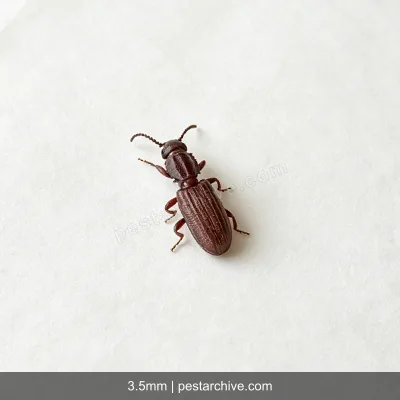
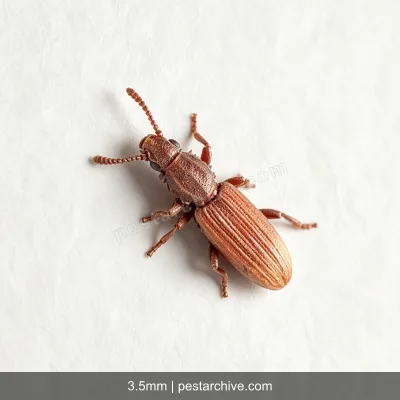
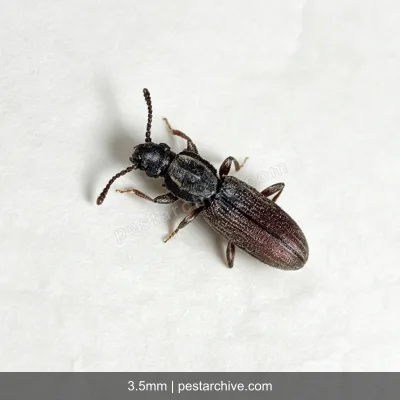
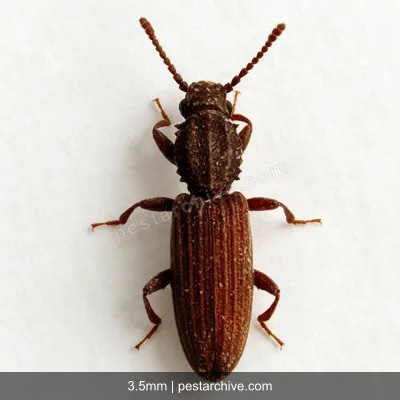
- Much smaller, only 3-4 mm.
- Body flat and elongated, dark brown.
- The most distinctive feature is the saw-toothed ridge along each side of the thorax—hence the name.
- Moves relatively fast.
Damage to grain
Both adults and larvae are voracious. Their damage includes:
- Direct feeding — eating rice grains, broken rice, flour, dried fruits, nuts, etc.
- Biting through packaging — the larger grain borer has powerful mandibles that can puncture plastic bags and paper packaging.
- Contaminating grain — grain they crawl over develops a pungent, off-odor (from secretions and feces).
- Promoting mold — damaged grain fragments are more susceptible to moisture and mold.
Sources of infestation
- Brought in with grain packaging.
- Emerging from old stored grain.
- Breeding in kitchen crevices.
- Spreading from neighbors along pipes.
Reproductive characteristics
Their lifecycle is relatively long, but under favorable conditions they can still cause severe damage:
- Larger grain borer: Egg to adult takes about 2-4 months; adults live 1-2 years.
- Saw-toothed grain beetle: Egg to adult takes about 3-5 weeks; reproduces faster.
- Both prefer warm (25-30°C) environments with 60-70% humidity.
- They are highly tolerant of starvation; larger grain borers can survive several weeks without food.
What to do if found
- Inspect all grain—they can bite through packaging, so sealed containers are not immune.
- Freeze infested grain for 48 hours to kill all life stages, or discard if heavily infested.
- Completely empty cabinets; vacuum all debris and powder from crevices.
- Wipe interiors with a damp cloth; after drying, clean storage areas and apply food-grade diatomaceous earth for protection.
- Thereafter, store all dry goods in airtight containers—they can bite through ordinary plastic bags.
- Inspect monthly, especially long-unmoved stock.