House Flies
(Common housefly, Filth fly)*Musca domestica*
Identification & Appearance
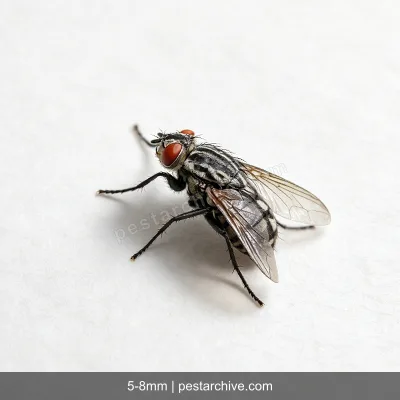
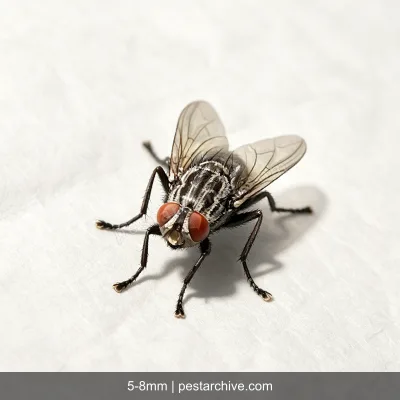
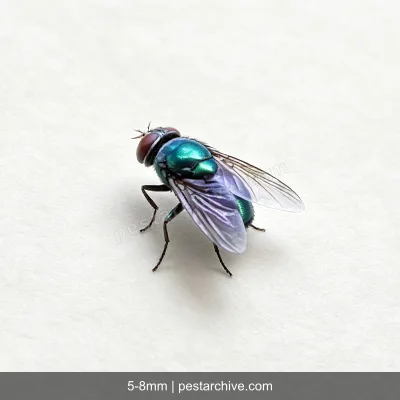
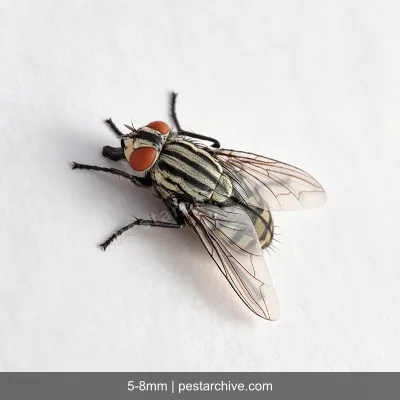
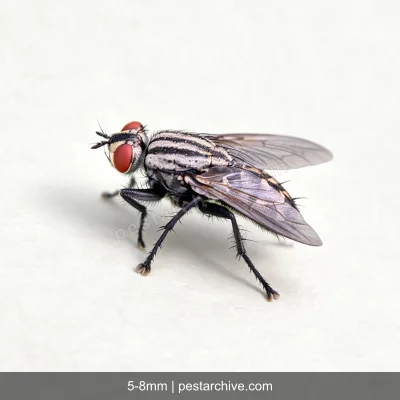
House flies (Musca domestica) are the most familiar and intimately associated hygiene pests of human dwellings. Adults measure 5-8mm, gray-brown with four dark stripes on the thorax, reddish-brown compound eyes, and sponging-lapping mouthparts. Their feet have sticky pads enabling them to walk on smooth vertical surfaces and even upside down on glass. At 25-30 C, the egg-to-adult cycle takes just 7-14 days with 10-12 generations per year. A single pair could theoretically produce trillions of descendants from April to August under ideal conditions. House flies can mechanically transmit over 100 pathogens including Salmonella, E. coli, Vibrio cholerae, poliovirus, and various parasite eggs.
Habits & Hiding Places
House flies feed on all manner of decaying organic matter: kitchen waste, animal feces, rotting produce, and carcasses. They regurgitate digestive fluids onto food to dissolve it before sponging it up, depositing saliva and feces on every surface they visit. Indoors, they concentrate around door and window areas (primary entry), kitchens and dining areas (attracted by food odors), and balcony-dried foods and pet bowls. They are excellent fliers with nearly 360-degree vision from their compound eyes. They can detect food odors from several kilometers away. Most active in summer; activity drops below 15 C. Breeding sites are primarily outdoors, with adults flying indoors.
Health Risks & Damage
- House flies are among the most important human hygiene pests — their bodies carry over 100 pathogens including bacteria, viruses, fungi, and parasite eggs. They transfer these directly to food and surfaces after feeding on garbage and feces. WHO estimates fly-transmitted diseases kill hundreds of thousands annually worldwide.;
- Their feeding behavior — regurgitating and re-ingesting — contaminates food with pathogens and fly eggs. Even cutting away the visibly contaminated portion may leave pathogen residues.;
- Buzzing flight and repeated landing on skin and food cause intense irritation.;
- Indoor flies signal sanitation gaps: unsealed garbage, uncovered food, damaged screens. Core solutions: install and maintain screens, seal and remove garbage daily, keep food covered.
Season & Region
Cosmopolitan. Density begins rising in Apr; Jun–Sep is the annual peak activity period. Most active at 30–35 °C; below 9–10 °C can only crawl. Overwinters as pupa. A single female can produce thousands of offspring; extremely rapid reproduction. Vigorous daytime activity with pronounced phototaxis.
| Region | Active Period | Peak Season | Notes |
|---|---|---|---|
| N. Hemisphere Temperate | Apr–Oct | Jun–Sep | Summer peak; density declines after Sep |
| N. Hemisphere Subtropical to Tropical | Year-round | May–Oct | Year-round reproduction; highest summer density |