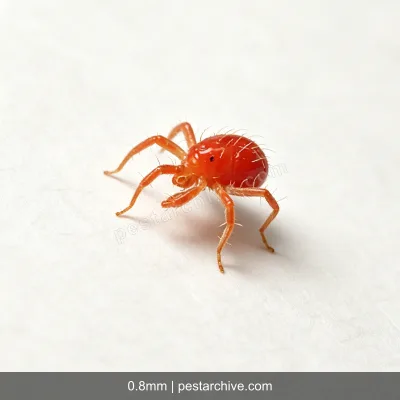
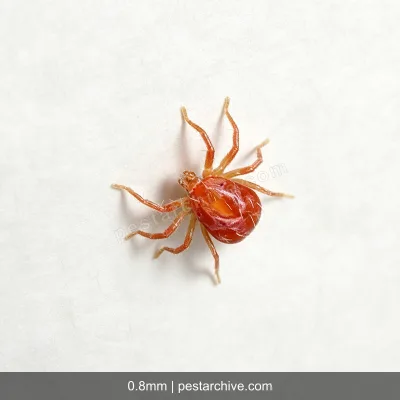
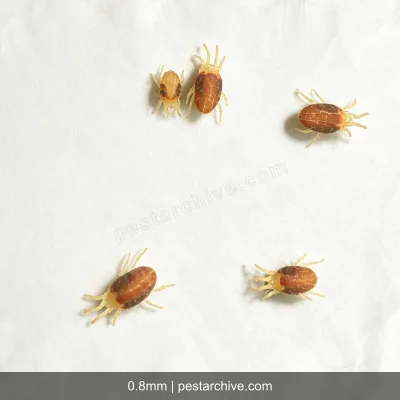
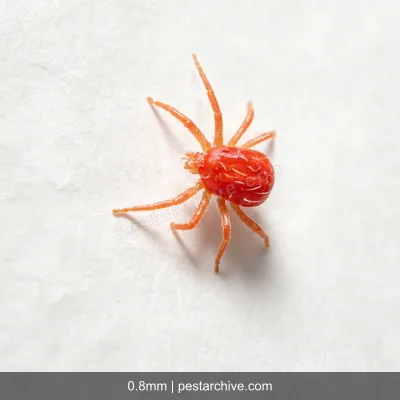
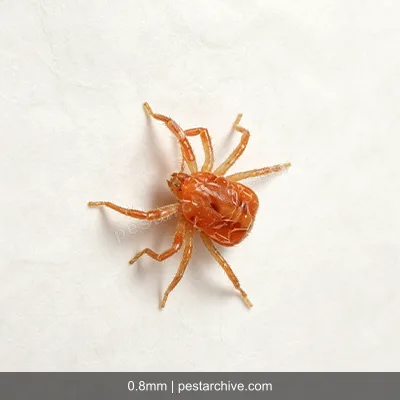
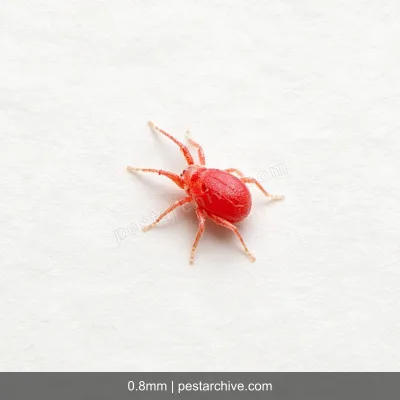
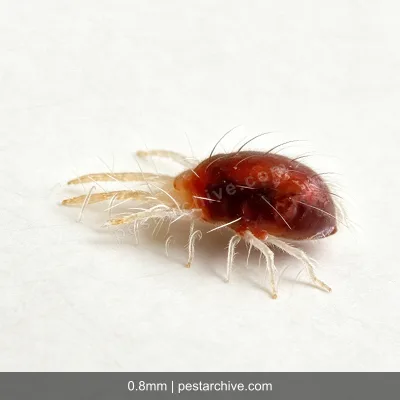
Spider Mites
(Red spider mite, Bryobia mite, Clover mite)*Tetranychus urticae* / *Bryobia* spp.
Identification & Appearance
Spider mites (family Tetranychidae) are tiny plant-feeding mites. Common household species include the clover mite (Bryobia praetiosa) and brown wheat mite (Bryobia graminum). Adults measure just 0.5-0.8mm, oval, reddish-brown to dark green, with disproportionately long front legs — a key feature distinguishing them from other spider mites. Unlike red spider mites (Tetranychus urticae), clover mites do not produce silk webbing. At 22-28 C and 40-60% humidity, the cycle takes 3-4 weeks with 5-8 generations per year. They breed fastest in hot, DRY conditions — the opposite of most other plant pests.
Habits & Hiding Places
Spider mites feed on plant sap, puncturing leaf undersides to suck out cell contents. Hosts include roses, clover, lawn grass, and many ornamentals. Indoors, they concentrate on leaf undersides (causing fine yellow-white stippling on upper surfaces), new shoots and leaf tips, balcony lawns and moss pots. They thrive in hot, dry conditions (25-30 C, 40-50% humidity). Unlike most pests, dry indoor winter air actually favors mite reproduction. They disperse by wind, on tools and clothing, and with new plants.
Health Risks & Damage
- Feeding causes dense yellow-white stippling on leaves. Leaves turn yellow from bottom up, curl, lose luster, and drop prematurely. No honeydew is produced — leaves appear dry and desiccated rather than sticky.;
- Populations can double every 2-3 weeks. One infested plant can spread to all balcony plants within 1-2 months.;
- Severe infestations cause complete growth stoppage, massive leaf drop, and branch dieback. Small or weak plants can die within weeks.;
- They do not bite humans or transmit disease. Mild skin itching in sensitive people from heavy contact.;
- Increasing humidity (frequent leaf misting) suppresses reproduction. Wipe leaf undersides with a damp cloth. Use dedicated miticides — ordinary insecticides have limited effect on mites.
Season & Region
Cosmopolitan. Reproduction fastest under hot, dry conditions (25–30 °C, RH 40–50 %).
| Region | Active Period | Peak Season | Notes |
|---|---|---|---|
| N. Hemisphere Temperate | Apr–Oct | Jun–Aug | Fastest reproduction under hot-dry conditions |
| N. Hemisphere Subtropical | Mar–Nov | May–Sep | Highest density in warm-dry seasons |