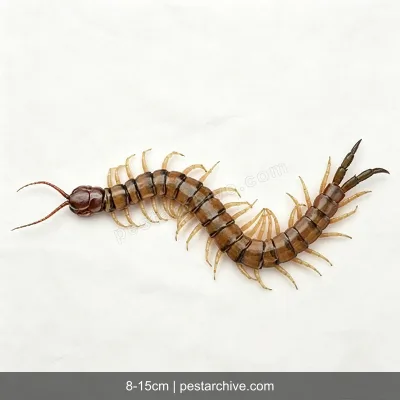
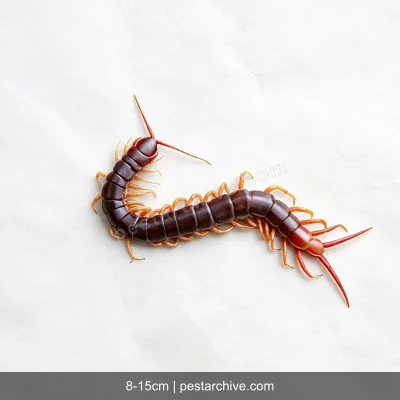
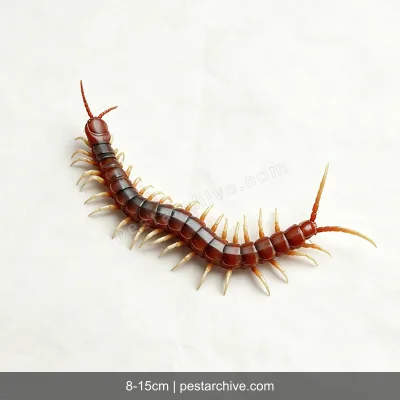
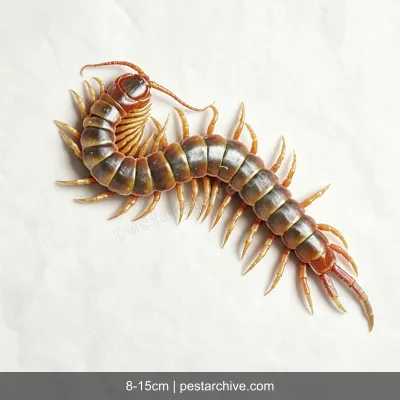
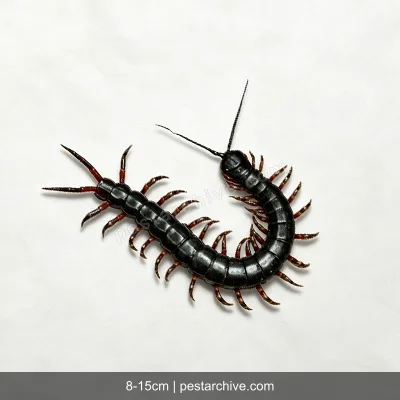
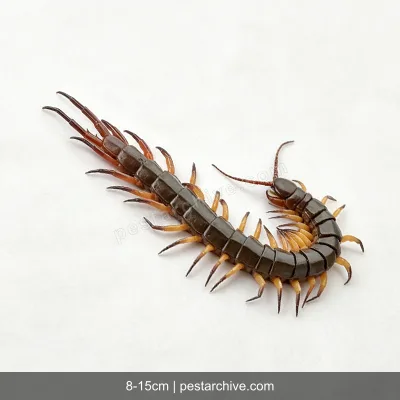
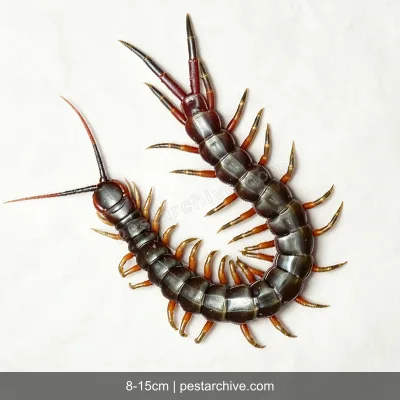
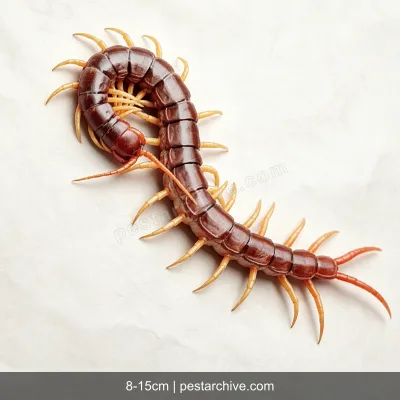
Centipedes
(Giant centipede, Scolopendra, Stone centipede)*Scolopendra mutilans* / Scolopendridae
Identification & Appearance
Centipedes belong to the order Scolopendromorpha within Chilopoda and are among the most feared household arthropods. Common household species include the Chinese red-headed centipede (Scolopendra mutilans, 8-15cm) and the giant centipede (Scolopendra subspinipes, 10-20cm). Adults are elongated and flattened, reddish-brown to black-brown, composed of 21-23 body segments, each bearing one pair of legs. The first pair of legs is modified into venom claws (forcipules). Centipedes differ from house centipedes in being larger, flatter, with shorter, stouter legs (one pair per segment), versus the house centipede's extremely long, slender legs and three dorsal stripes. Centipede bodies are thicker and more rigid; they move with a steady, deliberate gait rather than darting. Centipedes develop gradually through multiple molts, requiring 2-3 years to mature in warm conditions. Females show maternal care — curling protectively around their eggs until hatching. Adults can live 5-6 years. Centipedes are carnivorous, feeding on insects, spiders, earthworms, and small vertebrates. Their venom claws inject neurotoxic venom for hunting and self-defense.
Habits & Hiding Places
Centipedes are carnivorous predators, feeding on insects, spiders, earthworms, cockroach nymphs, and more. Indoors, they are most commonly found in: ground-floor and low-level unit corners, balconies, and bathrooms (the primary indoor entry areas — centipedes enter through exterior wall cracks, door/window gaps, and drainage pipes. After rain especially, centipedes are more likely to migrate indoors to avoid flooding); hallways and building entrances (outdoor landscaping and leaf litter are natural centipede habitats; they travel along wall foundations through hallway gaps into various floors); chronically damp indoor corners — laundry rooms, bathrooms, under kitchen sinks (dark, damp areas where centipedes temporarily shelter and hunt other insects); and corners with stacked cardboard boxes and clutter (providing centipede hiding spots). Centipedes are nocturnal, hiding in stone crevices, under leaf litter, in wall cracks, and in floor gaps during the day. They are sensitive to vibrations and quickly retreat into crevices or assume a defensive posture when disturbed. In nature, they live under rubble, dead wood, and in surface soil. Centipedes are solitary; indoor sightings are typically isolated individuals that will not establish a breeding population.
Health Risks & Damage
- Centipede bites are among the most medically significant household arthropod events. When venom claws pierce the skin and inject venom, intense pain follows (similar to or worse than a bee sting), with localized redness, swelling, warmth, and lymphangitis. Symptoms typically peak within hours to 24 hours and gradually resolve over 2-5 days in most cases. Individuals allergic to centipede venom may experience systemic reactions (nausea, dizziness, palpitations); medical attention is needed in rare cases. Children and pets are more sensitive to the venom and should avoid contact.;
- Centipedes' large size and rapid movement cause intense fear when suddenly encountered in home corners or bathrooms. Their nocturnal activity means they are more likely to be discovered after lights-out or in the early morning, creating ongoing anxiety for residents.;
- Centipedes do not damage building structures or furniture and do not contaminate food. Their primary impact is bite risk and fear. Occasional sightings generally do not warrant panic — sealing door/window gaps and clearing outdoor leaf litter and debris accumulations effectively reduce centipede entry.;
- In nature, centipedes prey on pests and have ecological value in controlling insect populations. Finding a centipede indoors should also prompt checking for other pest infestations — centipedes sometimes follow cockroaches, ants, and other prey indoors.
Season & Region
Cosmopolitan. Active period Apr–Oct; emerges from hibernation after the Waking of Insects (Jingzhe, early March). Peak activity around the summer solstice (Jun–Jul). Most frequent during hot, humid weather. Nocturnal hunter; photophobic.
| Region | Active Period | Peak Season | Notes |
|---|---|---|---|
| N. Hemisphere Temperate | Apr–Oct | Jun–Aug | Highest density during hot, sultry summer weather |
| N. Hemisphere Subtropical | Mar–Nov | May–Sep | Longer active season in south; marked increase during Meiyu |
| Tropical | Year-round | Rainy season | Year-round activity |