Chiggers
(Harvest mites, Red bugs, Berry bugs, Scrub itch mites)*Leptotrombidium deliense* / Trombiculidae
Identification & Appearance
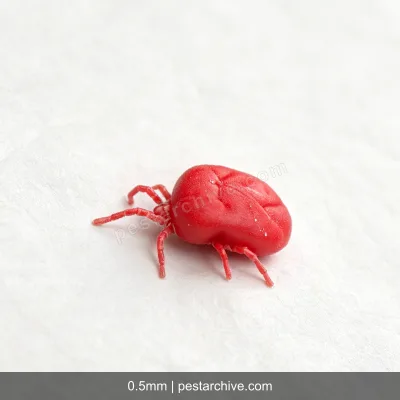
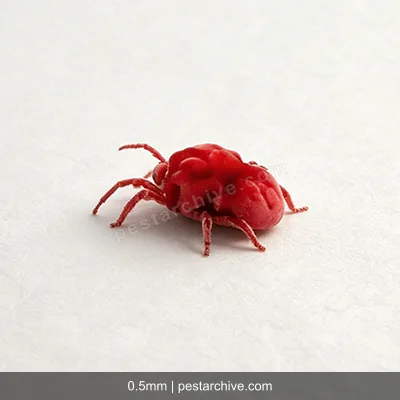
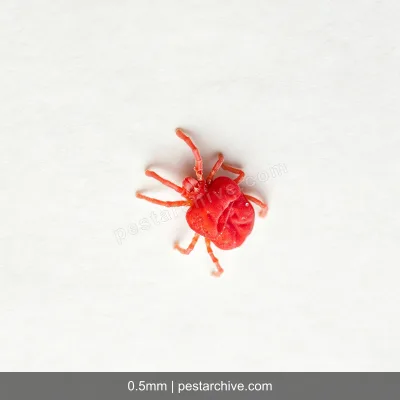
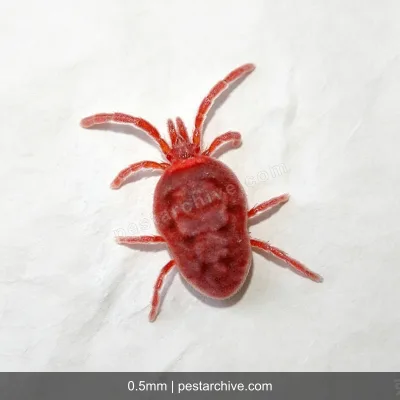
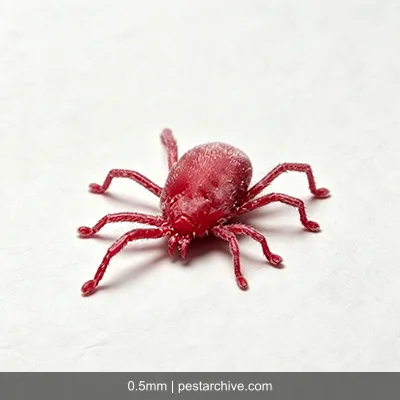
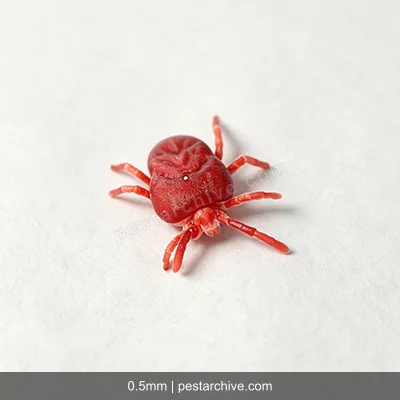
Chiggers, also known as harvest mites or red bugs, are the parasitic larval stage of mites in the family Trombiculidae — the only life stage that feeds on hosts. Chigger larvae are extremely tiny at 0.2-0.5mm, barely visible to the naked eye, appearing orange-red or pale red with a body densely covered in fine hairs, resembling a microscopic fuzzy ball. Only the larval stage is parasitic; nymphs and adults feed on small arthropod eggs and organic debris. The larval mouthparts are piercing-sucking. Rodents (rats, mice) are the primary natural hosts; humans are bitten when they contact infested environments during outdoor activities. Over 3,000 chigger species are known worldwide. Medically important species in China include Leptotrombidium deliense and L. scutellare. Chiggers undergo a complex life cycle: egg, larva, nymphochrysalis, nymph, imagochrysalis, and adult, taking about 2-3 months in warm seasons.
Habits & Hiding Places
Chiggers appear indoors primarily because pets or people bring larvae in from outdoor activities. Chigger larvae concentrate in outdoor grassy areas, shrubs, rice field edges, and streamside vegetation — sitting, lying, or walking through these environments risks chigger attachment. Around the home, chigger larvae are most commonly found in: balconies and entryways (first indoor contact points from returning outdoors), pet beds and surrounding areas (dispersal zone after pet carriage), carpets and sofas (where larvae may drop off after pets rest), baseboards and clothing storage areas (potential hiding spots), and outdoor flower pots, lawns, and around vegetation (potential breeding environments). Chigger larvae do not actively travel far — they climb grass tips and wait for passing hosts, then crawl to find thin-skinned areas for feeding.
Health Risks & Damage
- Chigger bites manifest as red papules with a central blister or ulceration, accompanied by intense itching. Scratching readily leads to skin breakdown, ulceration, and secondary bacterial infection. In severe cases, deep dermal ulcers (called 'chigger sores') can form, taking a long time to heal and potentially leaving scars.;
- Chiggers are the primary vector of scrub typhus (tsutsugamushi disease), caused by Orientia tsutsugamushi. After an infected chigger bite, a 4-21 day incubation period is followed by fever, headache, muscle aches, and lymphadenopathy. A characteristic black eschar (scab) appears at the bite site. Without timely treatment, multi-organ dysfunction can develop, and severe cases can be fatal. Scrub typhus is widely distributed across East and Southeast Asia, with southern China (Guangdong, Fujian, Yunnan) as the main endemic region.;
- Chigger larvae are virtually impossible to see with the naked eye, and their bites are painless — people typically only realize they've been bitten days later when rashes and itching appear. After outdoor activities (especially in grassy or streamside areas), shower and change clothes promptly, and check the body for bite signs. Regularly mow home lawns and yard vegetation to reduce larval habitat.
Season & Region
Cosmopolitan. Common in grasslands, riparian zones, and field edges.