Rove Beetles
(Whiplash beetle, Tomcat, Antlike beetle)*Paederus fuscipes* / Paederus spp.
Identification & Appearance
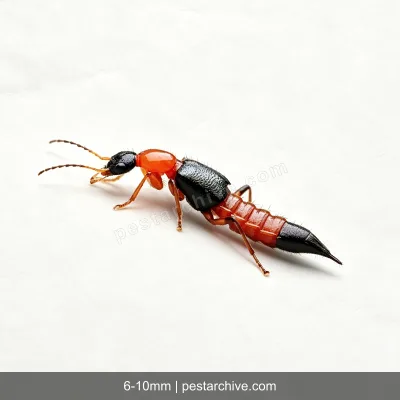
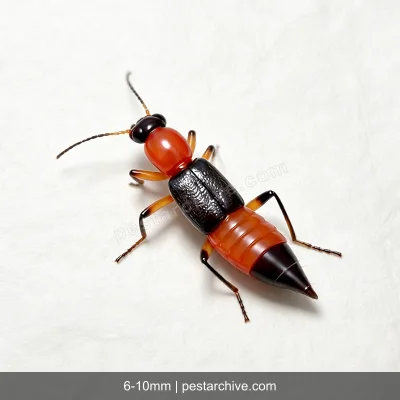
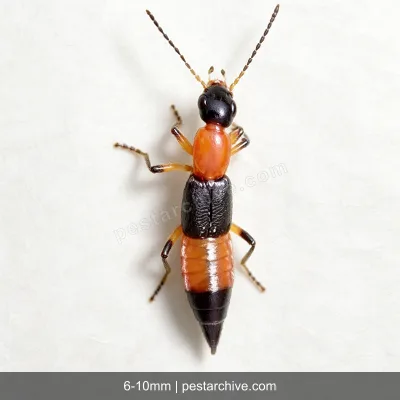
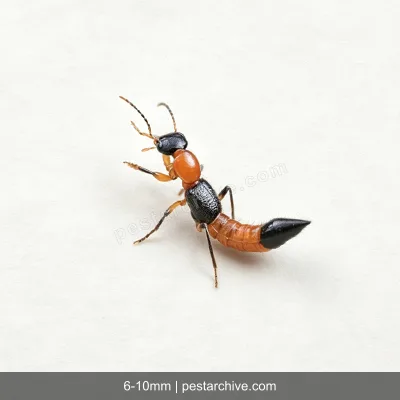
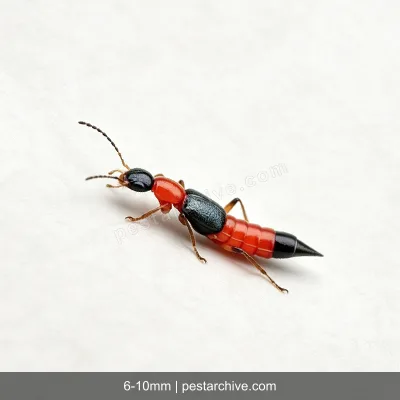
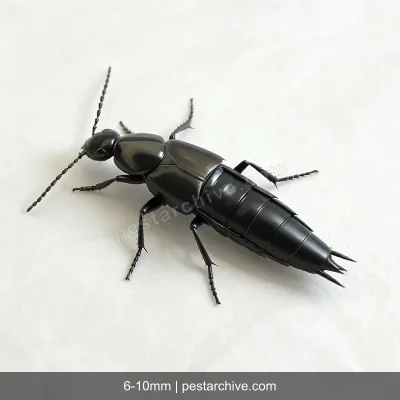
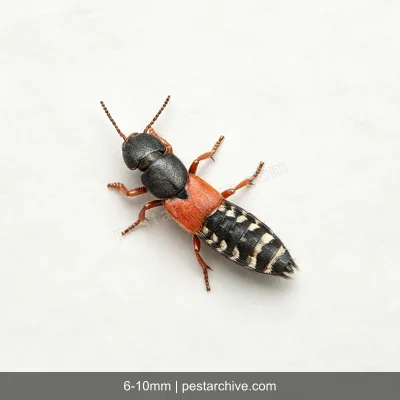
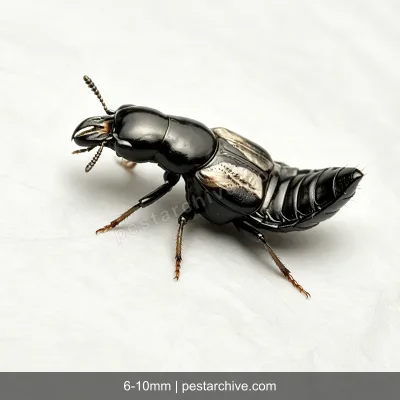
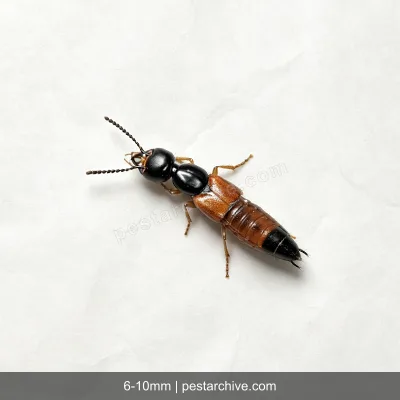
Rove beetles (family Staphylinidae) are elongated beetles. The most medically important household species belong to the genus Paederus. Adults measure 6-10mm, with distinctive black-and-orange banded coloration. Their forewings (elytra) are extremely short — hence the name 'rove beetle' — covering only the thorax, leaving most of the abdomen exposed. The hindwings are long and transparent, folded beneath the short elytra. The head is black, the pronotum orange, and the abdomen black with blue-green metallic sheen. The most critical fact about Paederus rove beetles is that their body fluid contains pederin — a potent corrosive amide toxin more powerful than cobra venom — but the toxin is only released when the beetle is crushed or pressed against the skin. A live beetle crawling on skin does NOT release pederin. Rove beetles undergo complete metamorphosis: egg, larva, pupa, adult. Larvae live in moist soil and humus, preying on small insects. Adults are most active in summer and are strongly attracted to light. Paederus species are widely distributed south of the Yangtze River and are important medical insects in summer and autumn.
Habits & Hiding Places
Rove beetle adults are predatory, feeding on small arthropods. Larvae live in moist humus environments. Indoors, they are most commonly found on: windowsills and curtains (the most frequent sighting locations — Paederus beetles are strongly phototactic, attracted to lights at night and landing on windowsills, walls, and curtains. Activity increases after rain when humidity is high, with large numbers flying toward light sources); balcony walls and laundry hanging outdoors (beetles active at night may land on clothes, towels, and bedding drying on balconies — bringing clothes in the next morning without checking and then slapping or crushing a beetle can cause severe skin injury); and entry doors and hallway lights (beetles fly from outdoors toward hallway lights, entering through door gaps. Ground-floor and second-floor units near farmland, woods, and landscaping are most affected). Rove beetles are primarily nocturnal, hiding in grass, leaf litter, and under stones during the day. Paederus beetles occupy diverse habitats — from rice paddies and vegetable fields to residential landscaping. Their flight ability is moderate; they rarely reach high floors (significant reduction above the 5th floor), primarily affecting mid- and low-level units.
Health Risks & Damage
- Paederus dermatitis (linear dermatitis) caused by rove beetle toxin is a common summer skin condition. When a beetle is crushed or smeared on skin, pederin contacts the skin and within 12-24 hours produces linear or patchy erythema that rapidly develops into blisters and pustules with intense burning pain and itching. The skin lesions have a highly characteristic appearance — irregular linear streaks, scratch-like marks, or patches matching the path along which the beetle was crushed or smeared.;
- Paederus dermatitis favors exposed areas — face, neck, and limbs. After healing, post-inflammatory hyperpigmentation commonly persists for weeks to months. Severe cases may involve systemic symptoms such as fever and regional lymphadenopathy. Eye contact with the toxin can cause acute conjunctivitis and, in severe cases, corneal damage.;
- The key to preventing Paederus dermatitis: NEVER crush or slap a beetle found on the skin — gently blow it away or brush it off with a soft object. Wash the contacted area with soap and water after any beetle contact. If dermatitis symptoms have already appeared, seek medical attention promptly for topical corticosteroid treatment.;
- Rove beetles do not damage clothing or furniture, contaminate food, or breed indoors — indoor sightings are almost always attracted adults flying in due to phototaxis. Prevention focuses on physical barriers (screens, turning off lights, closing windows) rather than chemical spraying. In high-risk areas, the most effective prevention is closing screens at night and minimizing unnecessary light exposure during summer.
Season & Region
Cosmopolitan. Active Apr–Oct; peak Jun–Sep. Hot, rainy weather provides optimal breeding conditions. Strong nocturnal phototaxis; easily enters buildings through door/window gaps. Hemolymph contains potent vesicant toxin (pederin — "flying acid"); do NOT crush on skin. Numbers gradually decline after Oct.
| Region | Active Period | Peak Season | Notes |
|---|---|---|---|
| N. Hemisphere Temperate | May–Oct | Jul–Sep | Summer heat/humidity peak |
| N. Hemisphere Subtropical to Tropical | Apr–Oct | Jun–Sep | Southern regions are high-incidence areas with greatest species richness |