House Centipedes
(Scutigera, Silverfish centipede, Leggy bug)*Scutigera coleoptrata*
Identification & Appearance
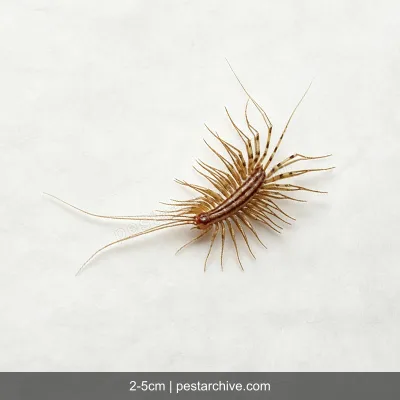
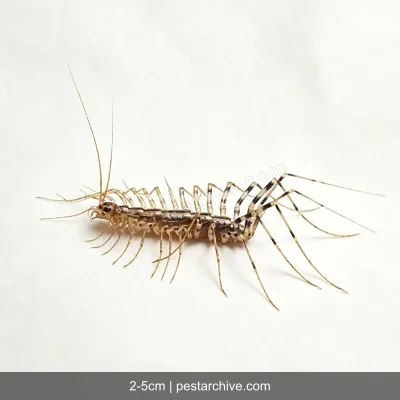
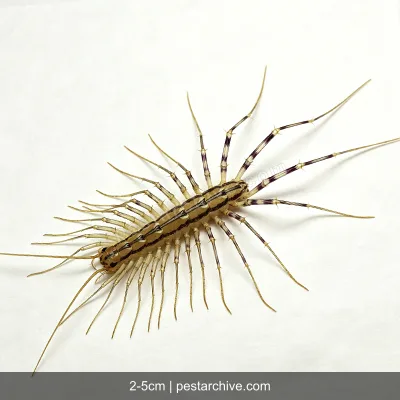
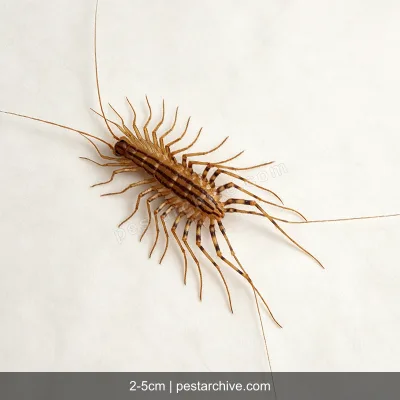
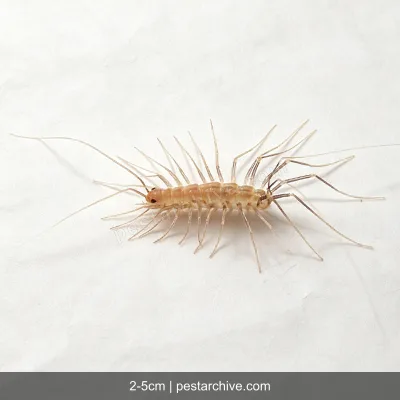
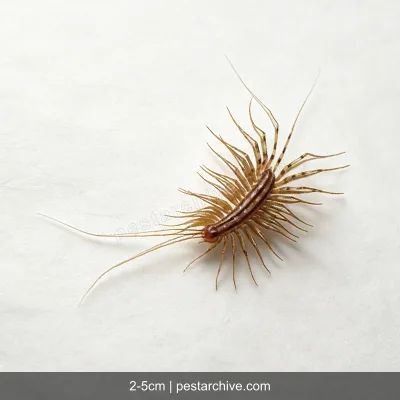
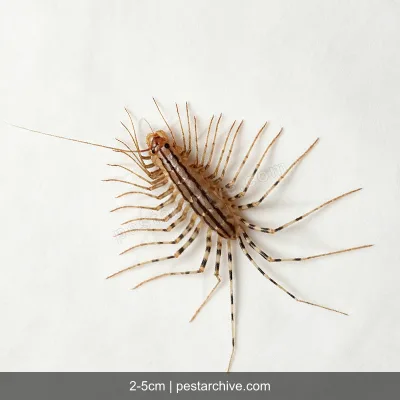
House centipedes (Scutigera coleoptrata) belong to the order Scutigeromorpha within Chilopoda. Adults measure 2-5cm in body length (leg span up to 8cm), with yellowish-brown to grayish-brown bodies bearing three dark longitudinal stripes on the dorsal surface. The most distinctive feature is their extremely long, numerous legs — 15 body segments, each with one pair of legs, with the last two pairs extending well beyond the body length, giving them a striking, almost fringe-like appearance. The last pair of legs is noticeably longer than the body and is often mistaken for antennae from a distance — but the true antennae are at the front, while these elongated rear legs are used for sensing and defense. House centipedes have venom claws (forcipules) to capture prey, but their venom is far less potent to humans than that of true centipedes. They develop gradually through multiple nymphal stages, with leg count increasing with each molt. House centipedes are extraordinarily fast runners — up to 40cm per second — a key advantage for both evading predators and capturing prey. They are photophobic, hiding during the day and hunting at night.
Habits & Hiding Places
House centipedes are carnivores that prey on other small arthropods — cockroach nymphs, ants, spiders, silverfish, booklice, drain flies, and more. They are actually one of the few beneficial arthropods in the home, helping to control other pest populations. Indoors, they are most commonly found in: bathrooms and washrooms (the most frequent sighting area — tile grout, around floor drains, under bathtubs, and other dark, damp spots); balconies and corner areas (hunting and hiding zones); basements and ground-floor rooms (more common in southern China's humid regions); and under beds, behind cabinets, and under sofas (undisturbed dark spaces where they hide during daylight). House centipedes are highly dependent on moisture — they easily desiccate in dry environments, which is why bathrooms and kitchens are their primary indoor habitats. They hunt at night, hiding in crevices during the day. When hunting, they charge at prey with incredible speed, inject venom to paralyze it, then consume it. House centipedes are widely distributed in temperate and subtropical regions globally. Scutigera coleoptrata is originally from the Mediterranean region but has spread worldwide with human activity. In nature, they live in leaf litter, under stones, and beneath bark. They tend to enter homes seeking warmth in autumn as temperatures drop.
Health Risks & Damage
- Despite their alarming appearance — extremely long, slender legs and darting movements that trigger fear — house centipedes pose far less danger than true centipedes. Their venom claws are relatively weak and struggle to pierce human skin. On the rare occasion of a bite, it causes only mild localized redness and stinging — far milder than a bee sting — and requires no special medical treatment.;
- House centipedes are actually beneficial household predators — they feed on cockroach nymphs, ants, spiders, silverfish, booklice, and other pest species. Finding an occasional house centipede indoors typically indicates the presence of other insect problems. Indiscriminately killing house centipedes removes a natural pest control agent from your home.;
- House centipedes occasionally crawl into beds or clothing, causing alarm, but they do not actively attack humans. Their long, slender legs are fragile and easily break off — detached legs may twitch briefly, a defensive mechanism to distract predators.;
- House centipedes do not damage building structures, chew furniture or clothing, or contaminate food. Rather than focusing on the house centipede itself, it's more productive to investigate whether there are more serious insect infestation issues in the home — because house centipedes only appear where there is prey to sustain them.
Season & Region
Cosmopolitan in warm, humid environments. Late spring to early summer (Apr–Jun) is the peak emergence period. Favors dark, damp environments; nocturnal predator. Agile; often found in bathrooms, kitchens, and other humid locations. Reproduction accelerated in warm, humid seasons.
| Region | Active Period | Peak Season | Notes |
|---|---|---|---|
| N. Hemisphere Temperate | May–Oct | Jun–Aug | Summer humidity peak; low winter activity |
| N. Hemisphere Subtropical | Mar–Nov | May–Jul | Peak density in late spring/early summer |
| Tropical | Year-round | Rainy season | Year-round reproduction |