Biting Midges
(No-see-ums, Punkies, Sand gnats)*Culicoides* spp.
Identification & Appearance
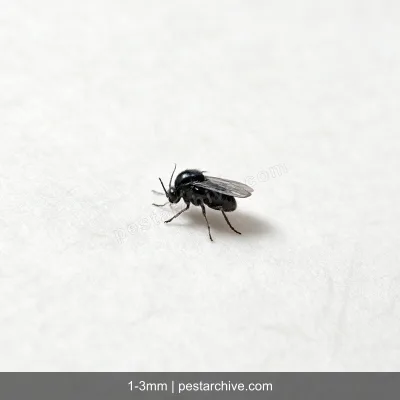
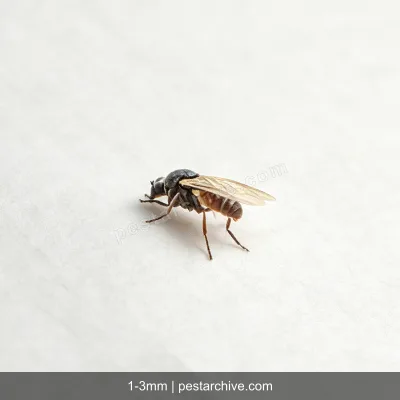
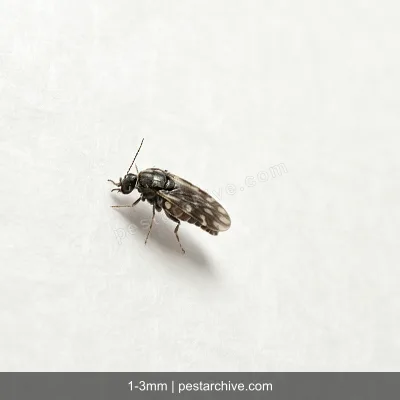
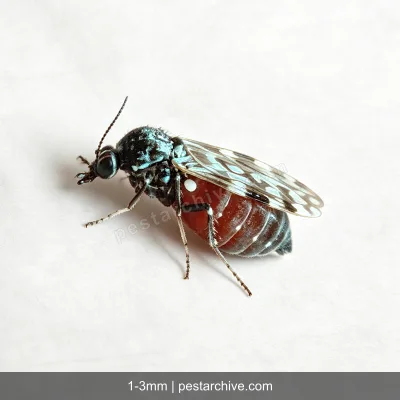
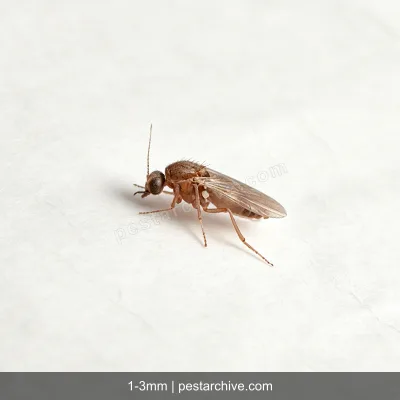
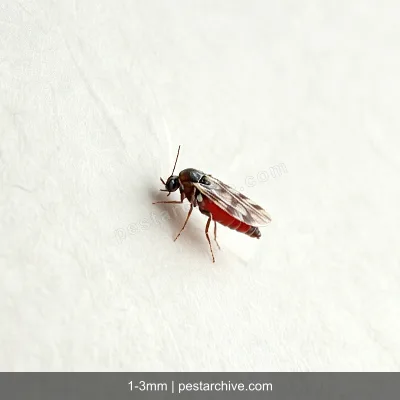
Biting midges, also known as no-see-ums, punkies, or biting gnats, are tiny blood-feeding flies in the family Ceratopogonidae. Adults measure only 1-3mm, with gray-brown to black slender bodies and short, broad wings. Though related to mosquitoes (both in Diptera), midges are far smaller. Their antennae are short, thick, and hairy; mouthparts are piercing-sucking. Only females bite — they require a blood meal to produce eggs. At rest, their wings lie flat over the back in a V-shape, often with dark patches on the wing surface. The most common household-relevant species in China belong to the genera Culicoides, Leptoconops, and Lasiohelea, with Culicoides being the most prevalent. Midges undergo complete metamorphosis: eggs are laid in moist soil, humus, or water surfaces; larvae develop in water or wet soil. The egg-to-adult cycle takes about 4-6 weeks, with multiple generations per year.
Habits & Hiding Places
Their minuscule size (1-3mm) allows midges to pass through standard window screen mesh effortlessly. Midges typically stay within a few hundred meters of their breeding sites, so a large indoor population signals nearby breeding habitat. They are most active at dawn and dusk, with activity dropping in windy conditions. Indoors, biting midges are found around: door/window gaps and screen edges (primary entry points — their tiny size lets them pass through AC ducts and exhaust fan openings); balcony and bathroom corners (damp environments suitable for resting and breeding); potted plant soil and tray water (potential breeding sites); and baseboards and vents (resting spots). Midge larvae develop in water or moist organic matter. Eliminating standing water and damp corners around the home is the single most effective way to reduce midges at the source.
Health Risks & Damage
- Midge bites appear as red papules or tiny blisters with a visible central puncture point, causing intense itching. Bites typically appear on exposed areas like lower legs and arms, sometimes in linear succession. Persistent scratching can lead to secondary infection and significant swelling. Because midges are so small, people often don't notice being bitten — waking up to discover multiple bite marks is common.;
- Midges often swarm in large numbers, forming visible 'midge clouds' at dusk that disrupt outdoor and window-adjacent activities. A single breeding site can produce tens of thousands of midges per day.;
- Despite their small size, midge numbers can be enormous. Once established near a home, standard window screens cannot keep them out — screens with 40+ mesh count are needed. Midge larvae breed in moist environments; eliminating standing water and improving drainage are the fundamental long-term control measures. Peak flight activity runs from summer to early autumn; keeping the environment dry significantly reduces breeding.
Season & Region
Cosmopolitan. Crepuscular activity peaks at dusk and dawn. Adults only 1–3 mm; can pass through standard window screens.
| Region | Active Period | Peak Season | Notes |
|---|---|---|---|
| N. Hemisphere Subtropical to Tropical | Apr–Nov | May–Sep | Highest species diversity; dense near water bodies |
| N. Hemisphere Temperate | Jun–Aug | Jul–Aug | Short season but high density |